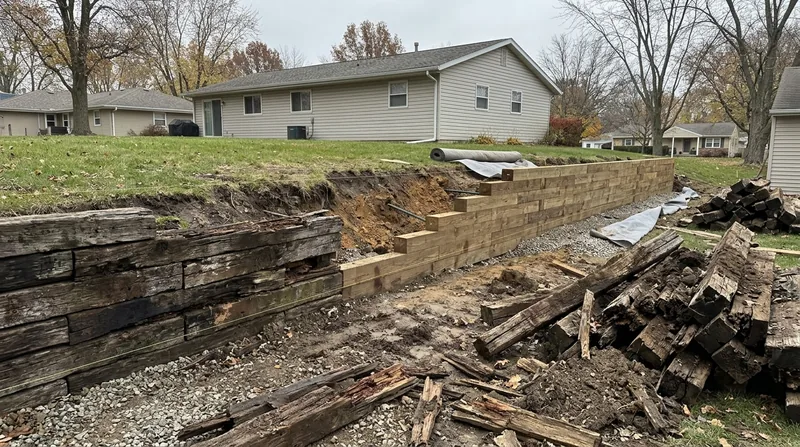




Railroad Tie Wall Replacement in Fort Wayne is one of the most common retaining wall jobs we handle across Allen County and the surrounding suburbs. Fort Wayne's glacial lake plain, clay till, and deep seasonal freeze-thaw cycles have taken their toll on the landscape timber and creosote railroad tie walls that homeowners installed throughout the 1970s, 1980s, and 1990s. Those walls are now sagging, leaning, and failing under the weight of backfill and the relentless push of spring snowmelt and winter ice. We remove deteriorated railroad tie walls, haul away the creosote-treated timber safely, rebuild the drainage system, and install a new wall in block, concrete, or Indiana limestone that will hold for decades. If you have a tired railroad tie wall on your property in Fort Wayne, New Haven, Huntertown, or any other Allen County community, we can assess the damage and give you a clear replacement plan.
Why Railroad Tie Walls Fail in Fort Wayne: Understanding the Local Failure Mode
Railroad tie walls built in the 1970s and 1990s looked good on the surface, but they were never designed to withstand Fort Wayne's extreme climate and soil conditions. Our clay till and glacial lake plain soils hold water poorly, creating hydrostatic pressure that pushes outward against the wall face. Winter freezing cycles expand that trapped water, and spring thaw floods the backfill zone. The creosote-treated ties themselves degrade over 30 to 40 years, losing structural integrity and splitting along the grain. Combine heavy, slow-draining clay, deep frost penetration, and repeated freeze-thaw stress, and even a well-built timber wall will lean, bow, and eventually collapse.
- Creosote timber loses strength after 30 to 40 years in acidic or wet soil, especially under clay-rich conditions.
- Hydrostatic pressure from poor drainage in glacial clay till pushes the wall face outward and destabilizes the toe.
- Freeze-thaw cycles in Indiana winters crack ties and heave the footing, breaking the bond between courses.
- Leaning and bowing walls indicate imminent failure and pose a safety risk to property and structures nearby.
- Deteriorated ties can no longer anchor geotextile or provide a stable base for a new drainage layer.
Addressing a failing railroad tie wall before it collapses prevents costly damage to foundations, driveways, and neighboring properties. We see this pattern repeat across Forest Park, Lakeside, Wildwood Park, and the post-war neighborhoods of Waynedale and Brookview.
Key info: A leaning railroad tie wall is a sign of imminent failure. The freeze-thaw cycle in Fort Wayne winters accelerates the breakdown of creosote ties and destabilizes the entire structure. Early replacement prevents foundation damage and safety hazards. Contact us at (260) 286-8196 for a free on-site assessment if you notice any bowing, leaning, or separation in your wall.
For more on recognizing wall failure, see our leaning and collapsed wall repair service.
How We Replace Railroad Tie Walls in Fort Wayne: A Step-by-Step Process
Railroad tie wall replacement is not a simple demolition and rebuild. We start with a site assessment to determine the wall height, measure the square footage, evaluate drainage and backfill conditions, and identify any permit requirements with the local building department. Fort Wayne and Allen County have setback and property-line rules that apply to walls above roughly 4 feet, so we always verify local code before we begin. Once the plan is clear, we remove and haul away the old ties and degraded backfill, install a proper gravel drainage layer, and build the new wall using the material and design that best suits your property and budget.
- We inspect the existing wall, measure the height and length, and identify any underground utilities or property line conflicts.
- We verify permit requirements with the Fort Wayne or local building department to ensure code compliance before demolition.
- We remove and haul away all creosote-treated railroad ties and deteriorated backfill material safely and responsibly.
- We excavate the footing area to proper depth and install a compacted gravel base for drainage and stability.
- We build the new wall using block, concrete, or Indiana limestone, depending on your preference and site conditions.
- We install geotextile and new gravel backfill to manage water and prevent future drainage failure.
- We compact all layers and ensure proper slope away from the wall to shed water and extend wall life.
This methodical approach takes longer than a quick tear-down and rebuild, but it prevents the same failure pattern from repeating in 20 years.
Example: A 30-foot railroad tie wall in the Aboite neighborhood near Leo-Cedarville, built in the 1980s, was leaning outward and had separated at the tie joints. We removed the deteriorated ties, installed a new concrete block wall with proper drainage and geotextile, and compacted 18 inches of gravel backfill. The job took 5 days, and the homeowner now has a wall rated to hold for 40+ years without maintenance.
Learn more about retaining wall drainage solutions that prevent future failure.
Railroad Tie Wall Replacement Methods and Materials
Not all railroad tie wall replacements look the same. The material you choose depends on your budget, aesthetic preference, and the specific demands of your site. A wall holding back a driveway cut in Huntertown may need more structural capacity than a landscaping wall in a Southwood Park garden. We offer three primary approaches, each with distinct advantages and cost profiles.
| Approach | Description | Best for |
|---|---|---|
| Concrete Block (SRW) | Segmental retaining wall blocks, interlocked and backfilled with geotextile and gravel. Fast to install, flexible design, and rated for drainage. Most common choice for residential replacement. | Residential walls up to 6 feet, driveway cuts, terraces. Best value and reliability for Fort Wayne clay till. |
| Poured Concrete | Monolithic concrete wall with integrated drainage and weep holes. Highest structural strength and durability. Requires formwork and curing time. | Tall walls, high surcharge loads, or where maximum longevity and minimal maintenance are priorities. |
| Indiana Limestone | Quarried glacial fieldstone or cut limestone blocks, mortared or dry-stacked. Matches the character of 1880s and 1910s Fort Wayne homes. Durable and beautiful. | Historic neighborhoods, West Central, Williams-Woodland Park, and homes where traditional aesthetics matter. |
| Timber (New)Pressure-treated or composite lumber, built with modern drainage and engineering. Not creosote. Extends timber wall life significantly but requires ongoing inspection. | Clients who prefer the look and feel of timber and are willing to perform periodic maintenance and inspection. |
Each method includes proper footing depth, drainage layer, geotextile, and compacted backfill. The choice depends on your budget, site conditions, and long-term maintenance preference. We help you weigh the trade-offs during the free estimate.
Railroad Tie Wall Replacement Cost in Fort Wayne: What to Expect
Railroad tie wall replacement in Fort Wayne typically ranges from $35 to $65 per square foot, depending on the material, wall height, site access, and drainage complexity. A 30-foot wall standing 4 feet tall (120 square feet) using concrete block might cost $4,200 to $7,800. Poured concrete or natural stone will run higher. The cost per square foot rises if the wall is taller, if access is difficult, if we need to remove significant amounts of deteriorated backfill, or if the footing is deeper due to poor soil conditions.
Several factors move the price up from that baseline:
- Wall height above 5 feet increases structural requirements and material costs significantly.
- Poor site access, tight spaces, or proximity to structures adds labor and equipment time.
- Extensive backfill removal and replacement due to clay saturation or contamination increases disposal and material costs.
- Permit and engineering drawings for walls over 4 feet or with significant surcharge add professional fees.
- Material choice: concrete block is most affordable; poured concrete and natural stone cost more per square foot.
We always provide a written estimate after an on-site visit. The estimate includes the material, labor, drainage, backfill, and haul-away. We do not charge for the estimate, and there is no obligation to book. For detailed pricing on different materials and wall heights, visit our full pricing page.
Tip: Get estimates from at least two contractors. Pricing can vary based on equipment, labor availability, and how each contractor assesses site conditions. A cheap estimate may not include proper drainage or adequate backfill compaction, leading to early failure. Our estimates include all materials, labor, and best practices to ensure the wall lasts 40+ years.
Railroad Tie Wall Replacement Near Me: What Fort Wayne Homeowners Should Know When Hiring a Contractor
Choosing the right contractor for your railroad tie wall replacement is as important as the material you select. A poorly executed job, even with good materials, will fail prematurely due to inadequate drainage, improper compaction, or incorrect footing depth. Before you call, understand what to look for: insurance status, proof of local experience, references from recent jobs, and a clear understanding of permit requirements in your city or township. Fort Wayne, New Haven, Huntertown, and surrounding areas each have their own building codes and setback rules, so your contractor must be familiar with local requirements.
- Verify that the contractor carries liability and workers compensation insurance.
- Ask for references from at least three recent railroad tie wall replacement or retaining wall jobs in Fort Wayne or nearby communities.
- Confirm that the contractor understands local permit thresholds and will work with the building department if required.
- Request a written estimate that itemizes material, labor, drainage, backfill, and haul-away costs separately.
- Discuss warranty or guarantee terms, including what is covered if the wall fails within a specified timeframe.
- Ask about the contractor's approach to drainage and how they ensure water does not accumulate behind the new wall.
A contractor who takes time to explain the failure of your old wall, walks you through the replacement process, and answers your questions is more likely to deliver a quality result than one who rushes to a price and a start date.
Fort Wayne Retaining Wall is fully insured. We have completed hundreds of railroad tie wall replacements across Allen County and surrounding areas, and we provide references on request. Call us at (260) 286-8196 or request a free estimate online to discuss your wall and get a clear plan forward.
Railroad Tie Wall Replacement in Fort Wayne: Pricing Guide
| Service | Price | Details |
|---|---|---|
| Concrete Block Wall Replacement | Starting at $35/sq ft | Material, labor, drainage layer, geotextile, and compacted gravel backfill included. Most affordable and popular choice for residential walls up to 6 feet in Fort Wayne. |
| Poured Concrete Wall Replacement | Starting at $50/sq ft | Formwork, concrete, drainage weep holes, and backfill included. Highest structural strength and durability. Cost rises with wall height and footing depth requirements. |
| Indiana Limestone or Natural Stone Wall | Starting at $60/sq ft | Quarried stone, mortar or dry-stack assembly, drainage, and backfill included. Premium material for historic neighborhoods and custom aesthetics. Labor-intensive installation. |
| Pressure-Treated Timber Wall Replacement | Starting at $40/sq ft | Modern pressure-treated lumber, hardware, drainage, geotextile, and backfill included. Not creosote. Requires periodic inspection and maintenance to extend lifespan. |
| Complex or Large-Scale Replacement | On estimate | Walls over 8 feet tall, engineered designs, difficult access, extensive site remediation, or multiple tiers require on-site assessment and custom pricing. |
| Free Estimate and Consultation | No charge | On-site visit, material assessment, local permit verification, and written proposal provided within 24 hours at (260) 286-8196. No obligation to book. |
Indicative pricing, the exact cost depends on square footage, finish, and site access. Free personalized estimate within 24h at (260) 286-8196.


