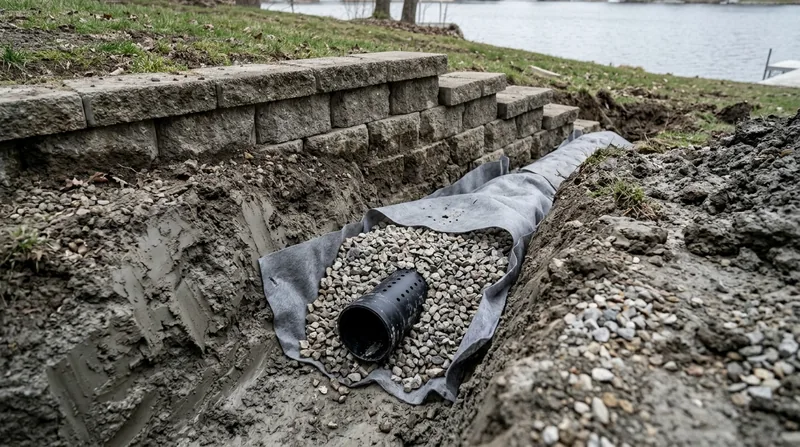




Retaining Wall Drainage in Fort Wayne is not optional in a city built on slow-draining clay till and glacial lake plain where freeze-thaw cycles run deep and spring snowmelt pushes water into every crack. Fort Wayne's flat terrain, heavy seasonal moisture, and the pressure of hard winter freezes make hydrostatic and frost pressure the leading causes of wall failure here. A wall that looks solid today can lean, crack, or collapse in two winters if water builds up behind it. Proper drainage, installed right from the start or retrofitted to a failing wall, is the single most cost-effective way to extend wall life and prevent catastrophic repair bills. We install French drains, weep holes, gravel backfill, and filter fabric that move water away from the wall face and relieve the pressure that destroys masonry, concrete, and timber.
Why Proper Drainage is Critical for Fort Wayne Retaining Walls
Fort Wayne sits where the St. Joseph and St. Marys rivers meet, on glacial lake plain and clay till that sheds water slowly. Winter freezes can push the ground table up by several inches, and spring thaw releases water that has nowhere to go except behind your wall. Without drainage, that water freezes, expands, and pushes the wall outward. Tired landscape timber and railroad tie walls from the 1970s and 1980s are failing across Waynedale, Brookview, and New Haven because no one installed drainage when they were built. Concrete and CMU walls along driveway cuts in Forest Park and Southwood Park crack and lean for the same reason. A well-designed drainage system catches that water before it becomes pressure.
- Install a French drain at the base of the wall to intercept groundwater and direct it downhill or to a daylight outlet.
- Drill weep holes through the wall face every 4 to 6 feet horizontally and 2 to 3 feet vertically to allow water trapped behind the wall to escape.
- Use gravel backfill and perforated drain pipe to create a permeable zone behind the wall that resists frost heave and hydrostatic pressure.
- Apply filter fabric between the gravel and native soil to prevent clay from clogging the drain and reducing its effectiveness over time.
- Slope the ground away from the wall or install a surface drain to shed roof runoff and snowmelt away from the foundation area.
Each of these steps works together to keep water moving and pressure low, so your wall stays plumb and solid for decades.
Local reality: The 1982 Maumee River flood left sandbag lines along riverbanks from New Haven to downtown Fort Wayne. That same hydrostatic pressure works against every wall on higher ground. Drainage is not an upgrade, it is survival.
For more information on how drainage fits into broader wall repair, see our Retaining Wall Repair page.
How We Install Retaining Wall Drainage in Fort Wayne: Step by Step
Our process begins with a site visit to assess soil conditions, water table depth, and the wall's current state of damage. Fort Wayne's dense clay and moraine ridges in Huntertown and Aboite mean we often encounter bedrock or impacted soil that requires different drilling and excavation techniques than sandy or loamy sites. We evaluate where water is coming from (groundwater, roof runoff, slope seepage), where it needs to go (daylight outlet, sump, storm drain), and what the wall is made of (concrete, block, stone, timber). Then we build a system that matches the site.
- Expose the base and rear face of the wall by excavating a trench at least 2 feet deep and 3 to 4 feet wide behind the wall.
- Install a perforated drain pipe with a gravel envelope at the base of the wall, sloped to a daylight outlet or sump pit downhill from the structure.
- Drill weep holes through the wall face using a rotary hammer and appropriate bit, spacing them 4 to 6 feet on center horizontally and 2 to 3 feet vertically.
- Backfill the trench with 1.5 to 2 inches of gravel, then lay filter fabric over the gravel to prevent soil infiltration into the drain zone.
- Regrade the surface to slope away from the wall at a minimum 5 percent slope for the first 10 feet, or install a surface drain channel to intercept runoff.
- Test the system by running water behind the wall to confirm drainage flow and weep hole discharge.
This methodical approach ensures water moves away from the wall, not into it.
Real example: A timber wall in Lakeside Park was leaning 3 inches out of plumb after 15 years. We excavated behind it, found clay and standing water, installed a French drain and weep holes, and regraded the lot. The wall stopped moving within one season. No replacement needed.
Learn more about our Leaning and Collapsed Wall Repair service if your wall is already failing.
Drainage Methods: Choosing the Right System for Your Wall
Not every wall needs the same drainage solution. A short garden wall in Wildwood Park may only need surface grading and weep holes. A tall segmental block wall supporting a driveway cut in Perry Township needs a full French drain system with filter fabric and a daylight outlet. A boulder wall on a creek bank in Leo-Cedarville may require a subdrain and surface channel working together. We size the system to the wall height, soil permeability, and water source.
| Approach | Description | Best for |
|---|---|---|
| Weep Holes Only | Drilled through the wall face at regular intervals to allow trapped water to escape and relieve pressure. | Short walls (under 4 feet), low groundwater, or supplemental drainage where surface grading is already in place. |
| Surface Drain and Regrading | Slope the ground away from the wall and install a surface channel or swale to intercept runoff and roof water before it reaches the wall. | Walls where water is primarily from roof runoff or snowmelt, and native soil is relatively permeable. |
| French Drain with Gravel Backfill | Perforated pipe at the wall base, surrounded by gravel and filter fabric, slopes to a daylight outlet or sump to intercept and remove groundwater. | Medium to tall walls (4 to 8 feet), clay or silt soil, or where groundwater is known to be present seasonally or year-round. |
| Composite System: French Drain, Weep Holes, and Surface Drain | Combines subsurface and surface drainage to handle both groundwater and runoff, with multiple pathways for water to escape. | Tall walls (over 8 feet), high water table, clay till, heavy snowfall areas, or walls supporting a driveway or structure (surcharge). |
Each system is designed to match Fort Wayne's soil, seasonal moisture, and the specific wall you are protecting.
Retaining Wall Drainage Cost in Fort Wayne: What to Expect
A basic drainage retrofit with weep holes and surface regrading starts at $2,500 for a wall under 30 feet long. A full French drain system with gravel backfill, filter fabric, and a daylight outlet runs $4,500 to $8,000 depending on wall length, trench depth, soil conditions, and whether bedrock or utility lines complicate the dig. Tall walls, composite systems, or walls in tight spaces (like Southwood Park where lots are compact) cost more because they require more labor and careful coordination. Fort Wayne's clay till and frost depth (typically 3 to 4 feet) mean we often dig deeper than contractors in sandier climates, which increases material and labor cost.
Factors that move the cost up include wall length, height, soil density, distance to a daylight outlet, presence of utilities or structures nearby, and whether the wall is already leaning or damaged. A wall that needs repair before drainage can be installed will cost more than a preventive installation on a new wall. Get two or three estimates before committing, and make sure each contractor explains what they are including (French drain only, weep holes, surface grading, filter fabric, testing) so you can compare apples to apples.
For a detailed pricing overview and to request a free estimate, visit our Pricing page or call (260) 286-8196.
Retaining Wall Drainage Near Me: What Fort Wayne Homeowners Should Know When Hiring
Hiring the right contractor for retaining wall drainage is as important as the drainage itself. A poorly installed French drain or weep holes that are spaced wrong or drilled at the wrong angle will fail to relieve pressure and waste your money. Look for a contractor who is fully insured in Indiana, has references from local Fort Wayne jobs, and understands the specific challenges of clay till and frost heave in northeast Indiana. Ask whether they have completed similar work in your neighborhood. Forest Park, Lakeside, and Wildwood Park have different soil and water tables than Huntertown or Leo-Cedarville, and a contractor who knows the moraine ridges and ravines in your area will design a better system.
- Verify that the contractor carries general liability and workers' compensation insurance.
- Ask for at least three references from drainage or retaining wall jobs completed in Fort Wayne or nearby areas within the last two years.
- Confirm that the contractor understands local permit requirements, setback rules, and whether your wall falls under Fort Wayne, township, or county jurisdiction.
- Request a written estimate that breaks down the cost by component (French drain, weep holes, gravel, filter fabric, regrading, testing) so you know what you are paying for.
- Discuss whether your homeowners' association or deed restrictions place any limits on wall modification or exterior work, and whether a permit is required.
- Ask about warranty or guarantees on the drainage work, and whether the contractor will return to inspect and maintain the system after installation.
A professional contractor will answer these questions clearly and provide a timeline and scope of work in writing.
Ready to get started? Contact us for a free, no-obligation estimate.
Retaining Wall Drainage in Fort Wayne: Pricing Guide
| Service | Price | Details |
|---|---|---|
| Weep Holes and Surface Regrading | Starting at $2,500 | Drilling weep holes through wall face, regrading slope away from wall, surface drain channel for short walls under 30 feet |
| French Drain Installation with Gravel Backfill | Starting at $4,500 | Subsurface perforated pipe, gravel envelope, filter fabric, daylight outlet, medium walls 4 to 8 feet tall, clay soil conditions |
| Composite Drainage System | Starting at $7,000 | French drain plus weep holes plus surface drain, tall walls over 8 feet, high water table, heavy clay till, surcharge conditions |
| Complex or Large-Scale Job | On estimate | Walls over 50 feet long, bedrock or utilities present, multiple tiers, retrofit of failed wall, or challenging site access requires on-site assessment |
| Travel and Site Visit | Included | No mileage fee or travel surcharge for Fort Wayne and surrounding service areas within 30 miles of downtown |
| Free Estimate | No charge | Professional site assessment, written proposal with itemized costs, no obligation to book, response within 24 hours at (260) 286-8196 |
Indicative pricing, the exact cost depends on square footage, finish, and site access. Free personalized estimate within 24h at (260) 286-8196.


