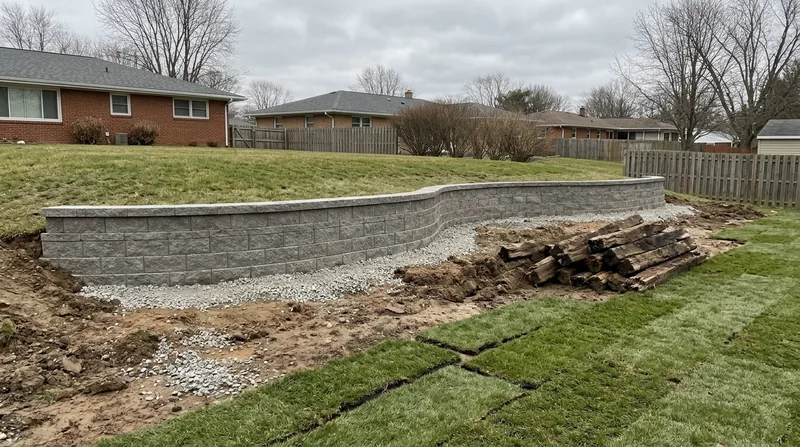




Retaining Wall Replacement in Fort Wayne is a critical investment when freeze-thaw cycles, heavy clay soil, and seasonal flooding have pushed your wall out of line or rotted it beyond repair. Fort Wayne sits where the St. Joseph and St. Marys rivers meet, on glacial lake plain and clay till that drains slowly and heaves hard in winter. Whether your wall is aging landscape timber from the 1970s, failed railroad ties, crumbling concrete, or segmental block that has settled unevenly, we remove the entire structure, haul it away, install proper drainage, and rebuild with engineered materials built to handle northeast Indiana winters. This page walks you through why replacement makes sense, how we do it, what it costs, and how to choose the right contractor.
Why Retaining Wall Replacement Matters in Fort Wayne's Climate and Soil
Fort Wayne homeowners face a unique set of wall-failure drivers. The region's deep frost, hard freeze-thaw cycles, and slow-draining clay till create conditions that push walls outward and collapse them from within. Spring snowmelt and occasional river flooding (the 1982 flood left sandbag lines along the riverbanks) add hydrostatic pressure that old walls simply cannot resist. Timber and railroad tie walls from the 1970s and 1980s are now rotting at the base, while poured concrete and CMU walls along driveway cuts and walk-outs are cracking and leaning. Segmental block terraces in newer subdivisions across Aboite, Perry Township, and Huntertown can settle unevenly when drainage fails or frost heaves the soil beneath them.
- We assess whether repair can save your wall or if full replacement is the only lasting fix.
- We install modern drainage systems that shed water away from the wall face and foundation, preventing the hydrostatic pressure that collapses tired structures.
- We choose materials and engineering suited to Fort Wayne's freeze-thaw cycle, not just aesthetic preference.
- We handle demolition and haul-away of failed walls, so you do not have to manage debris or disposal.
Replacing a failed wall now prevents catastrophic failure, erosion, and costly emergency repairs during spring thaw or heavy rain.
Key info: A rotting timber wall in Waynedale or a leaning concrete wall in Forest Park can fail suddenly, taking soil, landscaping, and even a driveway with it. Replacement with proper drainage and engineered materials stops that cycle and protects your property for 30 to 50 years.
For more detail on wall failures and repair versus replacement decisions, see our Retaining Wall Repair page.
Permitting note: Many Fort Wayne jurisdictions require a permit for walls above roughly 4 feet measured from the footing, or when a wall supports a surcharge such as a driveway or structure. Engineered drawings may be required for tall or tiered walls. Always verify thresholds with your local building department, as setback and property-line rules vary by zone. We handle permit coordination with the city or township on your behalf.
How We Replace Your Retaining Wall: Step-by-Step Process
Our replacement process starts with a site visit to evaluate soil conditions, drainage, grade, and the extent of failure. We then plan for safe demolition, proper debris removal, and installation of new foundations, drainage, and wall materials. The work unfolds in phases so you can see progress and understand exactly what we are replacing and why.
- We conduct a free on-site estimate, measure the wall footprint and height, photograph the failure, and review soil and drainage conditions.
- We obtain any required permits from the city or township building department and provide you with permit details and timelines.
- We demolish the old wall, remove all concrete, timber, or block, and haul away debris off your property.
- We excavate and prepare the footing, install perimeter drainage (typically perforated drain pipe and gravel), and compact the base.
- We build the new wall using engineered materials (concrete block, poured concrete, segmental retaining wall block, or natural stone) suited to your soil and grade.
- We backfill with proper drainage material, compact in lifts, and finish the top and face to your specifications.
The entire job typically takes 5 to 10 working days, depending on wall length, height, and site access. We coordinate around your schedule and minimize disruption to your yard and neighbors.
Local example: A homeowner in New Haven had a 35-foot railroad tie wall that was rotting at the base and leaning into their driveway. We demolished it over two days, installed a new perforated drain line at the footing, and built a 4-foot segmental block wall with proper backfill. The job took 7 days total, and the new wall has handled two winters with zero settling or movement.
For details on Retaining Wall Installation in new construction or landscape redesigns, visit our installation page.
Retaining Wall Replacement Methods and Materials
Different wall materials and construction methods suit different Fort Wayne properties, budgets, and soil conditions. Below is a comparison of the main approaches we use for replacement jobs.
| Approach | Description | Best for |
|---|---|---|
| Segmental Retaining Wall Block (SRW) | Interlocking concrete blocks, often with a slight backward batter, stacked and backfilled with drainage material. Modern engineered systems rated for freeze-thaw and designed for Fort Wayne soil conditions. | Most residential replacements in Aboite, Huntertown, and newer subdivisions. Attractive, durable, and rated for 30 to 50 years in northeast Indiana winters. |
| Poured Concrete | Monolithic reinforced concrete wall, typically 6 to 12 inches thick, with interior and exterior drainage. Engineered for load and frost depth. Smooth or textured finish options. | High-load applications, driveway cuts, and situations where a seamless, low-maintenance wall is needed. Common replacement for failed CMU walls in Forest Park and Waynedale. |
| Concrete Masonry Unit (CMU) Block | Standard concrete blocks mortared together, typically 8 to 12 inches nominal width, with interior drainage and sometimes exterior veneer. Proven performance in the region for decades. | Commercial and mid-scale residential replacements. Lower initial cost than SRW or poured concrete, but requires regular inspection and maintenance of mortar joints. |
| Boulder and Natural Stone | Large fieldstone or quarried stone stacked with gravel and drainage, sometimes with mortar. Indiana limestone and glacial fieldstone are traditional materials in the area. Allows water to percolate freely. | Cedar Creek ravines, river and creek banks, and heritage properties in West Central and Williams-Woodland Park. Provides natural appearance and excellent drainage in high-water areas. |
| Engineered Timber or Composite | Pressure-treated lumber or composite materials, typically 6 to 12 inches thick, with drainage and reinforcement. Longer lifespan than untreated timber but still subject to rot in very wet conditions. | Low-height garden walls and landscape borders. Not recommended for tall walls or high-load situations in Fort Wayne's freeze-thaw climate. We rarely recommend this for replacement of failed walls. |
Each material has strengths and trade-offs. During your estimate, we discuss which option best fits your budget, timeline, aesthetic goals, and the specific soil and drainage conditions of your property. For material-specific details, visit our pages on Concrete Retaining Walls, Block and Segmental Retaining Walls, and Boulder and Natural Stone Walls.
Retaining Wall Replacement Cost in Fort Wayne: What to Expect
The cost of retaining wall replacement in Fort Wayne depends on wall length, height, material choice, site access, drainage complexity, and whether the wall is tiered or supports a heavy surcharge. Most residential replacements in the Fort Wayne area start at $35 per square foot for basic segmental or concrete block walls with standard drainage. Taller walls, engineered poured concrete, or premium natural stone can run $50 to $75 per square foot or more.
A 40-foot wall that is 4 feet tall (160 square feet) with segmental block and proper drainage typically costs $5,600 to $7,200. A 50-foot wall that is 6 feet tall with poured concrete and engineered backfill can run $10,500 to $15,000. Site conditions, soil quality, and existing debris all move the price. Difficult access, poor drainage, or the need for additional site work (grading, erosion control, or slope stabilization) will increase the estimate.
We always provide a detailed written estimate that breaks down materials, labor, drainage, and any permits or engineering fees. We do not surprise you with add-ons. If the job scope changes during work (for example, we uncover severely compacted or contaminated soil), we notify you immediately and provide a revised estimate before proceeding.
For a full breakdown of pricing by material and job scope, visit our Pricing page. Call us at (260) 286-8196 for a free estimate tailored to your property.
Retaining Wall Replacement Near Me: What Fort Wayne Homeowners Should Know When Hiring a Contractor
Choosing the right contractor for retaining wall replacement is as important as the materials you choose. A poorly installed wall will fail again, no matter how good the materials are. Before you sign a contract, verify that your contractor is insured, and experienced in northeast Indiana soil and climate conditions. Ask for references from recent jobs in Fort Wayne, New Haven, Huntertown, or other local areas. A good contractor will explain the permit process, show you drainage details, and stand behind the work with a warranty.
- Confirm that the contractor carries liability and workers compensation insurance, with certificates available on request.
- Request at least two other estimates so you can compare scope, materials, timeline, and price across contractors.
- Ask for references from walls replaced in the past two years, and call those homeowners to ask about drainage performance, settling, and overall satisfaction.
- Verify that the contractor will obtain all required permits from your city or township building department and will coordinate with the inspector.
- Understand what warranty or guarantee the contractor offers, and get it in writing, including coverage for drainage failure, settling, and material defects.
A professional contractor will also discuss your HOA rules (if applicable) and any heritage or protected tree concerns before starting work. Fort Wayne has many mature trees along creek ravines and in established neighborhoods, so site preparation and drainage design must account for root protection and stability.
Ready to move forward? Contact Fort Wayne Retaining Wall today for a free, no-obligation estimate. We respond within 24 hours and will walk you through the entire replacement process, from permit to final inspection.
Retaining Wall Replacement in Fort Wayne: Pricing Guide
| Service | Price | Details |
|---|---|---|
| Segmental Retaining Wall Block (SRW) Replacement | Starting at $35/sq ft | Engineered interlocking blocks with perimeter drainage, backfill, and compaction. Price rises with wall height, site access difficulty, and drainage complexity |
| Poured Concrete Wall Replacement | Starting at $50/sq ft | Reinforced monolithic concrete with interior and exterior drainage. Higher cost reflects formwork, rebar, and engineering for load and frost depth |
| Concrete Masonry Unit (CMU) Block Replacement | Starting at $40/sq ft | Standard concrete blocks mortared together with interior drainage and optional veneer. Mid-range option for commercial and mid-scale residential walls |
| Boulder and Natural Stone Wall Replacement | Starting at $45/sq ft | Fieldstone or quarried stone stacked with gravel drainage. Price varies by stone type, availability, and site conditions; river and creek bank work may require additional permitting |
| Complex or Large-Scale Replacement | On estimate | Tiered walls, engineered slopes, erosion control, or jobs exceeding 150 linear feet require site assessment and structural design to provide accurate pricing |
| Free Estimate and Consultation | No charge | We visit your property, assess the wall failure, discuss materials and drainage, and provide a detailed written estimate with no obligation to book |
Indicative pricing, the exact cost depends on square footage, finish, and site access. Free personalized estimate within 24h at (260) 286-8196.


