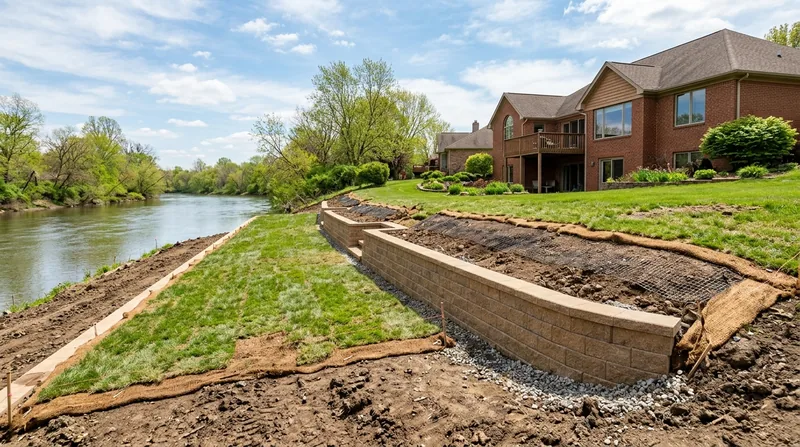




Fort Wayne sits where the St. Joseph and St. Marys rivers converge to form the Maumee, creating a landscape of glacial lake plains, moraine ridges, and wooded ravines that demand serious slope management. The region's heavy clay till, deep frost cycles, and spring snowmelt push unstable banks and hillsides toward failure every year, threatening homes, driveways, and yards across neighborhoods from Forest Park to Aboite to Huntertown. Slope Stabilization and Erosion Control in Fort Wayne is not optional when your property sits on or near a riverbank, creek bank, or moraine slope. We install terraced retaining walls with geogrid reinforcement and drainage systems to lock slopes in place, protect your foundation, and stop the freeze-thaw cycle from eating away at your land. If you own property along the St. Joseph, St. Marys, Maumee, or Cedar Creek, or on the higher ground of Aboite or Leo-Cedarville, slope failure is a real risk. Our work keeps water moving, soil stable, and your investment safe.
Why Slope Stabilization and Erosion Control Matters in Fort Wayne and Surrounding Areas
Fort Wayne's riverine setting and glacial geology create perfect conditions for slope failure. The freeze-thaw cycle, heavy spring runoff, and the weight of saturated clay till combine to push banks outward and downward. Homes built on walk-out basements in newer subdivisions, older properties with basement walls near stream channels, and yards backing onto the St. Joseph, St. Marys, or Cedar Creek all face accelerating erosion. Without intervention, you lose topsoil, see cracks in basement walls, watch driveways settle, and risk catastrophic collapse. A properly engineered retaining wall with drainage stops that process cold.
- We assess slope angle, soil composition, water flow, and surcharge load to size the wall correctly.
- We install geogrid reinforcement layers to bind soil and dramatically increase wall stability under freeze-thaw stress.
- We run drainage systems (perforated pipe, gravel) behind and below the wall to move water away from soil and reduce hydrostatic pressure.
- We set footings below the frost line (roughly 4 feet in Fort Wayne) to prevent heave and tilting.
- We terrace steep slopes with multiple wall runs to distribute load and allow vegetation to root into benches.
Each of these steps prevents the creep and failure that dominate slope problems in this region.
Key info: Many Fort Wayne jurisdictions require a permit for walls above 4 feet or when a wall supports a surcharge such as a driveway or structure. Always verify with your local building department before breaking ground. Engineered drawings may be required for tall or tiered walls.
For more on how we repair walls that have already failed, see our Leaning and Collapsed Wall Repair service.
How We Stabilize Slopes and Control Erosion in Fort Wayne
Our process starts with a site visit to measure slope angle, identify water flow paths, check soil type, and understand what load the wall must carry. We then design a wall system tailored to your soil, climate, and drainage reality. We mark the footing line, excavate to frost depth, set gravel base, and build the wall with proper backfill and geogrid layering. Every step is documented and tied to local code.
- We visit your property, measure the slope, identify the failure mode, and assess drainage patterns.
- We design the wall height, material, reinforcement layers, and footing depth based on soil bearing capacity and frost depth.
- We obtain permits from your local Fort Wayne or township building department if required.
- We excavate the footing trench to below frost line and set a stable gravel base.
- We build the wall course by course, installing geogrid every 18 to 24 inches of height.
- We backfill with compacted gravel and install perforated drainage pipe to direct water away from the soil.
- We grade and seed or landscape the bench behind the wall to establish vegetation and prevent surface erosion.
The result is a wall that holds for decades even under Fort Wayne's punishing freeze-thaw cycles and spring floods.
Local example: A property in New Haven with a walk-out basement backing onto a tributary of the St. Joseph was losing 6 inches of soil per year. We installed a 12-foot tiered wall system with geogrid and French drain, and the slope has held stable for 5 years with no new settlement or cracking.
Learn more about our Retaining Wall Drainage systems, which are critical to long-term slope stability.
Slope Stabilization Methods and Materials for Fort Wayne Conditions
| Approach | Description | Best for |
|---|---|---|
| Segmental Block with Geogrid | Modular concrete retaining wall blocks stacked and reinforced with geogrid fabric every 18-24 inches, with perforated drainage behind. | Steep residential slopes, walk-out basements, tiered terraces in Aboite and newer subdivisions. |
| Poured Concrete with Reinforcement | Monolithic concrete wall with embedded rebar and waterproofing, set on a deep footing and drained via a footer pipe. | High-load situations, driveway cuts, slopes supporting structures, maximum durability in freeze-thaw. |
| Boulder or Natural Stone Wall | Large glacial fieldstones or cut limestone set with proper grading and drainage, often tiered on steep terrain. | Riverbank and creek-bank stabilization, heritage properties, visual integration with historic Fort Wayne neighborhoods. |
| Geotextile with Vegetated Slope | Erosion-control fabric anchored with stakes and seeded with native grasses and root-binding species to stabilize shallow slopes. | Moderate slopes under 2:1, areas where a hard wall is not needed, environmentally sensitive sites near Cedar Creek. |
| Tiered Wall System | Multiple shorter walls stacked vertically with benches between, each wall reinforced and drained independently. | Very steep slopes, moraine ridges in Huntertown and Leo-Cedarville, maximum slope coverage with lower individual wall heights. |
Each method is chosen based on slope angle, soil type, water table, and what the wall must support. We match the material and design to Fort Wayne's clay till, frost depth, and seasonal water movement.
Slope Stabilization and Erosion Control Cost in Fort Wayne: What to Expect
The cost of slope stabilization depends on wall height, wall length, slope angle, soil conditions, drainage complexity, and whether the wall requires engineered drawings and permits. A simple 4-foot segmental block wall on a moderately steep slope might run $2,500 to $5,000 total. A tiered system on a steep moraine slope or a concrete wall supporting a driveway can easily reach $8,000 to $20,000 or more. The best way to know is to request a free estimate from our team, no obligation.
Factors that move the price up include wall height above 6 feet, difficult soil or high water table, tight access requiring hand work, tiered systems, engineered design drawings, and permit fees. Spring projects often cost more due to high water tables and freeze-thaw damage already visible. Winter and early spring are when we see the most urgent calls, so booking ahead in fall or summer can sometimes save money and guarantee scheduling.
We recommend getting 2 to 3 estimates to compare design approach, material choice, and price. A cheap estimate that ignores drainage or uses inadequate geogrid reinforcement will fail in Fort Wayne's climate. Our pricing reflects proper engineering, correct material selection, and drainage that lasts.
For a detailed breakdown of our pricing by project type, visit our full pricing page. Call us at (260) 286-8196 to schedule your free estimate today.
Slope Stabilization and Erosion Control Near Me: What Fort Wayne Homeowners Should Know Before Hiring
When you search for slope stabilization contractors near Fort Wayne, look for a insured company with verifiable experience in Fort Wayne's specific soil and climate. We are fully insured, and we provide proof of insurance on request. Check references from past projects in your area, particularly on riverbank or creek-bank work. Ask whether the contractor has handled similar slopes in your neighborhood (Forest Park, Waynedale, Aboite, Huntertown, New Haven, or Leo-Cedarville all have distinct terrain and drainage challenges).
Understand permit requirements before signing a contract. Many Fort Wayne jurisdictions and townships require a permit for walls over 4 feet or when a wall supports a surcharge. Some areas have setback rules or property-line restrictions. Your contractor should clarify this with your local building department before quoting. If you have an HOA, check its design guidelines and get approval in writing before work begins. An engineered drawing may be required for tall walls or unusual soil conditions, and that cost should be transparent upfront.
Ask the contractor how they handle drainage. A wall without proper drainage is a wall that will fail. Perforated pipe, gravel backfill, and geogrid reinforcement are non-negotiable in Fort Wayne. Request references from jobs at least 3 to 5 years old so you can see how walls have held up under our freeze-thaw cycles and spring flooding.
Ready to get started? Contact Fort Wayne Retaining Wall for a free, no-obligation estimate. Call (260) 286-8196 or fill out our online form. We respond within 24 hours and serve Fort Wayne, New Haven, Huntertown, Leo-Cedarville, Grabill, Woodburn, Auburn, Garrett, Butler, Waterloo, Kendallville, and surrounding areas.
Slope Stabilization & Erosion Control in Fort Wayne: Pricing Guide
| Service | Price | Details |
|---|---|---|
| Slope assessment and free estimate | Free | On-site visit, slope measurement, soil and drainage evaluation, design recommendation, no obligation to proceed |
| Small segmental block slope wall | Starting at $2,500 | 4-foot wall, 20-30 linear feet, moderate slope, single-run design with geogrid and drainage included |
| Medium tiered or tall wall system | Starting at $6,500 | 6-12 foot walls, tiered layout, geogrid reinforcement, engineered design, permits, drainage, and site restoration included |
| Complex slope or riverbank project | On estimate | Steep moraine slopes, multiple tiers, high water table, boulder or specialty materials, or structures requiring engineered drawings |
| Service area and travel | Included | No separate travel fee for Fort Wayne, New Haven, Huntertown, Leo-Cedarville, Grabill, Woodburn, Auburn, Garrett, and surrounding towns |
Indicative pricing, the exact cost depends on square footage, finish, and site access. Free personalized estimate within 24h at (260) 286-8196.


